
 Security Center
 ATM & Branches
LABOUR MARKET
|


How can we help?
Filter
Looks like we don’t have any matches for
Try a different search term or check out some of our suggestions below.

Frequently Asked Questions
Have questions about SAB banking services? Let us help you with these frequently asked questions.
FAQS
Customer Service
Our friendly Customer Support team are on hand to help with any queries you have. We're here to help!
Contact Us


WOMEN IN THE WORKFORCE DRIVING SAUDI’S GDP GROWTH
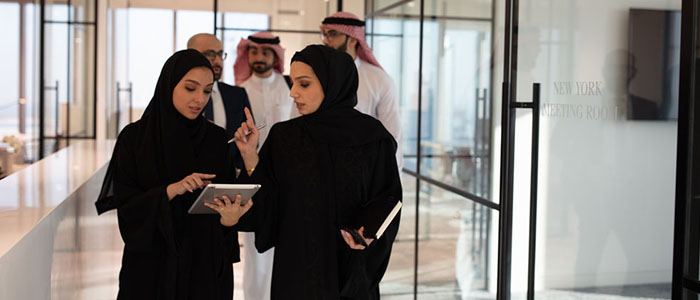
Saudi Arabia’s recent gains in female labour force participation are emerging as a meaningful contributor to medium-term economic growth.
Labour market reforms introduced under Vision 2030 have nearly doubled the female participation rate among Saudi nationals, rising to around 33.7% by the third quarter of 2025 from 19% in 2016.
For those aged 18 to 24, the rate increased from 10% in 2015 to 33% in 2025. Employment as a share of population has increased across all main education levels, according to a landmark World Bank report.
“Research indicates that achieving parity between women’s and men’s labour force participation could lead to an average increase of 20% in GDP per capita,” the World Bank noted.
OPENING DOORS TO WOMEN
Rising labour market participation among women is increasingly translating into employment gains. More women are moving out of inactivity, and fewer remain unemployed after entering the labour force, signalling improving absorption capacity in the job market. The increase in activity has been especially pronounced in recent years, with a notable rise in the share of women transitioning from inactivity to active participation between 2022 and 2025 compared with the 2012 to 2015 period, World Bank analysis shows.
The proportion of women leaving inactivity rose by roughly 6 to 7 percentage points, highlighting stronger engagement with the labour market. Earlier trends were less favourable: most women who became active in 2012 were still unemployed by 2015, indicating limited employment opportunities at that time.
Recent outcomes show a clear shift. A majority of women who transitioned out of inactivity after 2022 were employed by 2025, suggesting a significant improvement in labour market conditions for female entrants. This change points to stronger demand for labour and a more inclusive employment environment, where women are increasingly able to secure jobs after joining the workforce rather than remaining unemployed.
The shift has lifted the kingdom’s overall labour force participation to a record high and reinforced the expansion of the non-oil economy, which now accounts for well over half of GDP
If labour force participation continues to increase by roughly one percentage point per year over the next decade, annual real GDP growth could average 0.3 percentage points higher than under historical trends, according to a previous S&P Global report. Under this scenario, the Saudi economy could be approximately USD 39 billion larger by 2032 compared to a scenario in which participation growth reverts to long-term averages.
BOOSTING LABOUR PRODUCTIVITY
However, the analysis emphasises that expanding the workforce addresses only part of the growth equation. Long-run economic performance depends more heavily on labour productivity – output per worker – than on labour quantity alone. Using a growth-accounting framework based on historical productivity outcomes, S&P projects median real GDP growth of around 2.4% over the next 10 years if recent participation gains persist. This would still represent a slowdown from the 2000–2022 average, reflecting weaker population growth and uncertainty around productivity gains.
Vision 2030 aims to improve productivity through multiple channels: higher educational attainment, increased capital investment, technological adoption, and private-sector dynamism. Structural reforms targeting Saudisation, small- and medium-sized enterprise (SME) financing, and reduced reliance on public sector employment are intended to shift labour into more productive roles. Female advancement has been supported by rising education levels, declining fertility rates, cultural liberalisation, and policy measures such as childcare support, expanded remote work options, and the removal of guardianship requirements for business formation.
Saudi Arabia’s labour market strategy is on track to meet its 2030 targets and has already surpassed several key benchmarks set for 2025, according to the World Bank. As of mid-2025, labour force participation stood at 67.1%, well above the 2025 target of 61.8% and already exceeding the 2030 goal of 63.0%. The female labour force participation target for 2030 was reached ahead of schedule in 2022. The overall unemployment rate declined to 2.8%, outperforming both the 2025 target of 4.6% and the 2030 target of 3.8%.
Among Saudi nationals, unemployment was 6.8%, slightly better than the 2025 benchmark of 7% and moving toward the 2030 objective of 5.0%. Meanwhile, Saudi employment in the private sector rose to 52.8% for the first time, surpassing the 2025 target of 51.4% and progressing toward the 2030 goal of 58.3%.
Taken together, these indicators suggest sustained progress toward a more inclusive and dynamic labour market.

ECONOMY
Oil and non-oil sectors flex their muscles to keep the country humming, boosting business confidence and earning a ratings agency’s thumbs up.
MINERALS
A recent industry forum underscores the growing global interest in the kingdom’s mineral wealth as a shift to clean energy sparks demand for critical minerals.
RENEWABLES
The country appears to be on track to meet its ambitious target of supplying almost 50% of its electricity through renewable natural resources by 2030.
TRANSPORT
Improving inter-city links will not only boost passenger mobility and tourism flows, but also support the logistics sector and strengthen local supply chains.

Your are now leaving this site
Your are now leaving this site
You are about to leave this site. You are being redirected to an external site. Would you like to leave this site?










© SAB, Saudi Arabia. All Rights Reserved, 2025
Saudi Awwal Bank, a listed joint stock company, incorporated in the Kingdom of Saudi Arabia, with paid in capital of SAR 20,547,945,220, commercial registration certificate 1010025779, unified number 7000018668, Mailing Address: P.O. Box 9084, Riyadh 11413. National Address: 7383 King Fahad Branch Rd, 2338 Al Yasmeen Dist., 13325 Riyadh, Kingdom of Saudi Arabia, Tel. +966 11 4050677, www.sab.com, licensed pursuant to the Council of Ministers Resolution No. 198 dated 06/02/1398H and Royal Decree No. M/4 dated 12/08/1398H, and regulated and supervised by the Saudi Central Bank.