Search
 Security Center
 ATM & Branches
NIDLP

How can we help?
Filter
Looks like we don’t have any matches for
Try a different search term or check out some of our suggestions below.

Frequently Asked Questions
Have questions about SAB banking services? Let us help you with these frequently asked questions.
FAQS
Customer Service
Our friendly Customer Support team are on hand to help with any queries you have. We're here to help!
Contact Us


FOUR SECTORS PULL THEIR WEIGHT TO BUILD SAUDI’S ECONOMIC RESILIENCE
Launched in early 2019, the National Industrial Development and Logistics Program (NIDLP) is tasked with growing Saudi Arabia's energy, mining, industry, and logistics sectors, supported by two cross-cutting pillars: local content and the fourth Industrial Revolution. In 2025, the programme entered a more mature execution phase, shifting focus from meeting targets to maximising economic impact, according to its NIDLP 2025 Annual Report.
The report notes that NIDLP had a 91.9% performance rate against its 2021-2025 execution targets, with 93% of initiatives either completed or on track. By the end of 2025, NIDLP's four sectors together contributed more than USD 278.7 billion to GDP, up from USD 265.6 billion in 2024. Their combined share of non-oil GDP rose to nearly 39%. Non-oil exports exceeded USD 166.1 billion, up 14% years on year. Cumulative non-government investment in economic and industrial cities and special zones reached USD 390.9 billion.
The report also broke down each sector’s progress.
Energy: Renewable energy projects delivered record-low generation costs: the Al-Shuaiba solar plant reached 1.04 US cents per kilowatt-hour (kWh) – the world's lowest at the time – followed by Najran solar at 1.09 US cents per kWh. Al-Dawadmi wind reached 1.33 US cents per kWh and Al-Ghat wind 1.57 US cents per kWh, both among the lowest globally. Total capacity of signed power purchase agreements surpassed 43 gigawatts (GW), and renewable energy's share of the power mix rose to 15.64%.
Mining: Active mining licenses reachted 2,925, and the estimated value of mineral resources was put at over USD 2.5 trillion. Saudi Arabia climbed 81 places to rank 10th on the Mining Investment Attractiveness Index, and mining-related memoranda of understanding exceeding USD 26.7 billion were signed. Total annual exploration expenditure per square kilometre rose to USD 130.1, well above the 2024 target of USD 48. A Mining Innovation Studio and Global Mining Innovation Competition were launched to encourage technology adoption in the sector.
Industry: The number of industrial establishments reached 12,946, supported by 1,511 operating ready-built factories. Localisation in pharmaceuticals reached 30.5% (against a 29% target) and localisation in military industries reached 24.89% (against a 16.5% target); 347 companies were licenced in the military industries sector. Cumulative export value of promising industries reached USD 43.6 billion, well above the USD 32.2 billion target, and 2,894 valid final licences were issued for promising industries versus a target of 1,040. Notable projects included an aviation industries cluster in Jeddah, a multi-storey factories project in Dammam, and the MS Pharma plant, the country’s first fully integrated biopharmaceutical manufacturing facility.
Logistics: Customs clearance time fell to roughly two hours, down from 288 hours in 2016. The number of logistics centres with re-export links reached 24, against a target of 20, and infrastructure expansion included 24 logistics platforms and five new special economic zones. Port utilisation rose to 62%, up from a 50.2% baseline but short of the 70% target.
Meanwhile, local content in government procurement reached 51.2%, up from 33.7% in 2020. The mandatory list of national products grew by 449 items to over 1,670, covering 38,175 tenders worth more than USD 13.51 billion. Under the Fourth Industrial Revolution pillar, NIDLP inaugurated an Advanced Manufacturing and Production Center and developed what it describes as the world's fastest Quantum Random Number Generator.
LOGISTICS EXPANSION
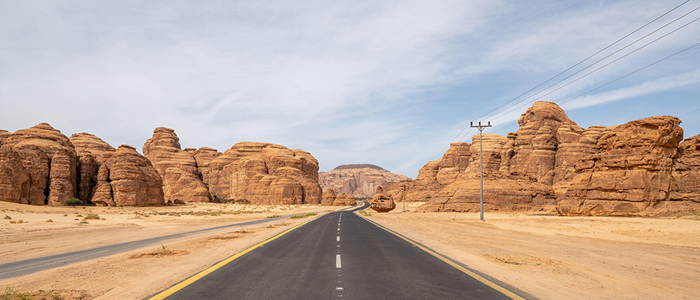
The progress has continued in 2026 with several projects under way, especially in logistics to boost access to a key economic, tourism infrastructure, with new routes connecting the country’s various region’s to the Red Sea coast.
The Roads General Authority (RGA) recently stated that the roads sector is a vital enabler for development, noting that Tabuk Region has a developed road network extending more than 5,304 kilometres (km). It is part of the overarching NIDLP programme aimed at boosting road, sea, air, and rail connections across the country’s key economic, manufacturing, tourism, and business hubs.
The Tabuk region network is a key route that enhances the region's position as one of the kingdom's leading tourist destinations and facilitates visitor access to its natural landmarks and coastlines. Travellers from Riyadh to The Red Sea destination can choose between three main routes, di ering in length, travel time, and the places they pass through.
The first and fastest route passes through Al-Majma'ah, Buraidah, and Al-Hanakiyah before reaching Madinah on the way to The Red Sea destination, covering approximately 1,255 km in about 12 hours and 25 minutes. The second route passes through Al-Quwayiyah, Afif, and Mahd Al-Dahab before reaching Madinah and then Umluj, covering approximately 1,355 km in about 14 hours and 20 minutes. The third and longest route passes through Al-Majma'ah, Buraidah, and Hail before reaching AlUla and Al-Manjour village, covering approximately 1,385 km in about 14 hours and 40 minutes.
The Red Sea destination continues to attract visitors with its extensive beaches, pristine islands, and diverse marine environment, o ering diving, boat trips, water sports, and coral reef exploration, alongside luxury resorts for those seeking tranquillity and privacy.

ECONOMY
The ambitious strategy was the push the country needed to transform and future-proof its economy in a fast-shifting global financial landscape.
GAMING
The industry can accelerate the development of a digitally skilled workforce, expand the local intellectual property, and promote technological innovation.
ISLAMIC FINANCE
The region accounts for more than 40% of global sukuk issuance, with the kingdom becoming one of the most significant issuers worldwide.
RENEWABLE ENERGY
Sustainable resource management allowed the country to increase access to safe drinking water while reducing consumption of non-renewable groundwater.

Your are now leaving this site
Your are now leaving this site
You are about to leave this site. You are being redirected to an external site. Would you like to leave this site?