Search
 Security Center
 ATM & Branches
INDUSTRIAL SECTOR

How can we help?
Filter
Looks like we don’t have any matches for
Try a different search term or check out some of our suggestions below.

Frequently Asked Questions
Have questions about SAB banking services? Let us help you with these frequently asked questions.
FAQS
Customer Service
Our friendly Customer Support team are on hand to help with any queries you have. We're here to help!
Contact Us


SAUDI’S NON-OIL ECONOMY ON SOLID FOOTING AS INDUSTRIES DELIVER GROWTH
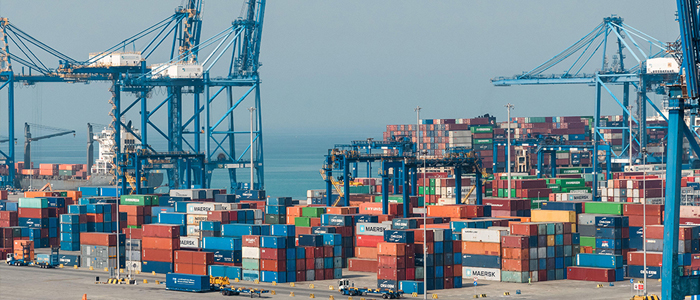
The National Industrial Development and Logistics Program (NIDLP) increased its contribution to the kingdom's non-oil economy in 2025, with growth across manufacturing, mining, energy, and logistics supporting broader e orts to diversify economic activity under Vision 2030.
According to the programme's 2025 annual report, sectors overseen by NIDLP contributed 1.045 trillion to non-oil gross domestic product, representing 39% of Saudi Arabia's non-oil economy, up from 996 billion in 2024. Overall, non-oil activities accounted for 55% of national GDP during the year.
The programme, launched to coordinate development across the energy, mining, industry and logistics sectors, is intended to strengthen industrial capacity, expand exports, improve supply chains and increase private sector investment. The latest report highlights progress across each of these areas as Saudi Arabia continues to reshape its economic base beyond hydrocarbons.
TRANSPORT AND LOGISTICS
The transport and logistics sector recorded further gains as new infrastructure entered service and trade volumes increased. The number of logistics centres supporting re-export activity rose to 24, compared with only two in 2019, reflecting Saudi Arabia's e orts to strengthen its position as a regional distribution hub, the report stated.
Port utilisation increased to 62%, up from a baseline of 50.2%, while customs clearance times remained stable at approximately two hours. Saudi ports handled 8.3 million containers during 2025, including 2.2 million transshipment containers, highlighting continued growth in maritime trade and cargo handling.
Rail infrastructure also expanded. Operations commenced on what the report describes as the world's longest railway network using the European Train Control System (ETCS) Level 2 signalling technology. During the year, the network transported more than 30 million tonnes of freight and carried over 14 million passengers, strengthening freight connectivity between industrial centres, ports and domestic markets while supporting broader supply chain efficiency.
Some of the key achievements in the logistics sector include the expansion of the South Container Terminal at Jeddah Islamic Port at an investment of USD 800 million, and the launch of SAL Logistics Zone covering more than 1.5 million square metres in Riyadh.
In addition, the NIDLP is also planning for the future with the launch of the Future Mobility Sandbox, in collaboration with the Ministry of Transportation and Logistics Services (MoTLS) in partnership with King Abdullah University of Science and Technology (KAUST), and in cooperation with the Ministry of Industry and Mineral Resources. It serves as the first regional testing environment of its kind, enabling the development and validation of future mobility solutions powered by artificial intelligence (AI) and clean energy, within an integrated model that seamlessly connects land, air, and sea transport.
ALTERNATIVE TRADE GATEWAY
The Port of NEOM on the kingdom’s west coast has expanded its role as a regional logistics hub by establishing a multimodal freight corridor linking Europe with the Gulf via Egypt and Saudi Arabia, providing an alternative route for truck-carried cargo.
Located on the Red Sea near major transport corridors, Port of NEOM continues to strengthen its position as a regional gateway, facilitating trade flows between Europe, Africa, Asia, and the Middle East.
The land bridge was enabled through Pan Marine Group's RoPax service between Egypt's Port of Safaga and Port of NEOM, launched at the end of 2025, and extended to Europe in March 2026 through a partnership with Danish shipping and logistics company DFDS.
The integrated route allows truck-carried freight to move directly from Europe through Egypt and Saudi Arabia to Gulf markets, o ering an alternative to traditional container shipping. The corridor is designed to support the movement of fast-moving consumer goods and other time-sensitive cargo.
The service is already being used by importers in Italy, the United Kingdom, Germany and Poland, providing access to the UAE, Oman, Kuwait, the wider GCC and Iraq through a single multimodal transport network.
The latest development builds on a 2025 pilot connecting Port Safaga in Egypt, with Port of Neom and onward to Iraq via the Arar border crossing. The trial demonstrated shorter transit times than conventional shipping routes, highlighting the e ciency of combining maritime transport with inland road networks.
By integrating European shipping networks with Red Sea maritime routes and Saudi Arabia's inland transport corridors, Port of NEOM is expanding freight connectivity between Europe and Gulf markets while providing additional routing options for regional supply chains.

ECONOMY
Strong business sentiment, declining unemployment figures, and stable sovereign credit rating have buoyed the country amidst challenging market conditions.
AGRICULTURE
Investments in sustainable greenhouses and smart farming technologies are already bearing fruit for the kingdom as its food self-su ciency ratio rises.
MANUFACTURING
Shared infrastructure and supply chains have allowed various industries in the kingdom to maximise resources and funding opportunities.
SAUDI EXCHANGE
Investors were able to hold their nerve, prompted by strong corporate earnings and the positive impact of ongoing economic reform policy in Saudi.

Your are now leaving this site
Your are now leaving this site
You are about to leave this site. You are being redirected to an external site. Would you like to leave this site?