Search
 Security Center
 ATM & Branches

Frequently Asked Questions
Have questions about SAB banking services? Let us help you with these frequently asked questions.
FAQS
Customer Service
Our friendly Customer Support team are on hand to help with any queries you have. We're here to help!
Contact Us


FDI FLOWS: SAUDI’S INDUSTRIAL SECTOR ENTERS NEW PHASE OF GROWTH
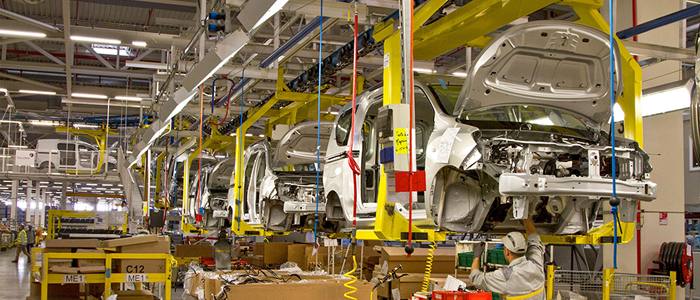
Saudi Arabia’s industrial sector is seeing a shift in how it is financed, produced, and positioned globally, with foreign investment reshaping the sector.
The Ministry of Industry and Mineral Resources reported a sharp acceleration in lending to industrial firms via financial technology, or fintech) platforms in 2025. Lending volumes reached SAR 774 million, representing a 36% annual increase. This compares with SAR 569 million in 2024 and SAR 317 million in 2023, suggesting a rapid scaling of alternative financing channels for industry.
The growth has been driven by a series of strategic partnerships between the ministry and domestic fintech firms, including Taamid, Yanal, Tarmeez Capital, Dinar, Sakkok, Lendo, and Forus. These collaborations aim to address long-standing financing constraints facing small and medium-sized industrial enterprises, particularly around liquidity and access to credit.
The ministry’s approach reflects a broader policy objective: embedding financial innovation into industrial development to ensure production continuity and enable scaling.
The ministry plans to expand its fintech-driven financing ecosystem in 2026. This includes growing the lending portfolio, introducing new financial instruments tailored to industrial needs, and intensifying outreach through workshops aimed at improving financial literacy among factory owners. There are also plans to broaden the network of partner platforms and beneficiaries, further deepening the integration between industry and digital finance.
INDUSTRIAL PRODUCTION INDEX
The gains are occurring alongside steady growth in industrial output. Saudi Arabia’s Industrial Production Index rose 8.9% year on year in February, reaching 114.6, while remaining broadly stable on a monthly basis. The expansion was led by mining and quarrying, which posted a 13% annual increase, reflecting higher oil production as well as sustained activity in extractive industries.
Manufacturing activity also contributed to growth, rising 3.6% year on year. This was supported by a 5.2% increase in coke and refined petroleum products and a 4.5% rise in chemicals and chemical products. However, on a month-on-month basis, manufacturing edged down by 0.2%, suggesting some short-term volatility within key subsectors.
Across manufacturing segments, performance was mixed. Non-metallic mineral products grew 2.2% annually, while basic metals manufacturing rose 6.2% year on year but declined 2% month on month. Paper products recorded modest annual and monthly gains, whereas electrical equipment manufacturing contracted 3.2% annually despite a slight monthly increase. Electricity, gas, and related supply activities declined 3.7% year on year, while water supply and waste management expanded by 8.1%, pointing to divergent demand dynamics across infrastructure segments.
Foreign investment trends reinforce this growth. In 2025, Saudi Arabia’s manufacturing sector attracted USD 18.4 billion in foreign direct investment commitments, according to data from the Ministry of Investment. Manufacturing now accounts for 31% of non-oil FDI inflows, more than doubling its share from 14% in 2022. This shift signals growing international confidence in the kingdom’s industrial strategy.
AUTOMOTIVE MANUFACTURING GROWTH
A key catalyst is the Public Investment Fund’s (PIF) push to localise supply chains across its vast portfolio. With USD 925 billion in assets, the fund exerts significant influence over procurement in the domestic economy. Its localisation requirements are prompting global suppliers to establish production facilities the kingdom rather than rely on imports.
Automotive component manufacturers are among the first movers, with mid-sized companies pursuing joint ventures in industrial zones.
Lucid Motors, in which the PIF holds a significant stake, inaugurated AMO-2, its first international manufacturing facility, in September 2023 at King Abdullah Economic City (KAEC) in Jeddah. The plant is geared toward exports, with approximately 92% of production destined for international markets, while around 13% is allocated to GCC countries.
Last year, Hyundai Motor Manufacturing Middle East broke ground on a new facility at KAEC.
Stellantis is also exploring vehicle manufacturing in the kingdom. Saudi Arabia's Ministry of Investment, the National Industrial Development Center (NIDC), Stellantis and auto products and service conglomerate Petromin Corp. signed a memorandum of understanding to evaluate the potential for developing a manufacturing plant to localise both commercial and passenger vehicle production.
Last year, Saleh Al-Sulami, CEO of NIDC, said the automotive industry in the country is expected to generate investments of around SAR 90 billion. Among the world’s largest importers of cars – with imports reaching 830,000 vehicles annually – the kingdom is aiming to make 350,000 vehicles locally

ECONOMY
Major indicators including business sentiment, foreign direct investment, and employment have been favourable, fuelling optimism for the country.
HEALTHCARE
Ongoing investments in health innovation and pharmaceuticals have made a profound impact on people’s quality of life in the kingdom.
REAL ESTATE
Expanding the pool of eligible buyers will increase demand for properties across the country’s major cities, especially in urban districts.
US-SAUDI TRADE
The nations are focusing on a more integrated economic engagement involving sectors like energy, technology, healthcare, aerospace, and infrastructure.

Your are now leaving this site
Your are now leaving this site
You are about to leave this site. You are being redirected to an external site. Would you like to leave this site?